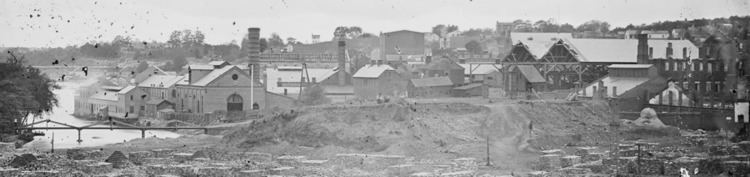
The Early Years (1837–1847)
Tredegar Iron Works begins in 1837 as an iron forge and rolling mill along the James River in Richmond, Virginia. The company initially made railroad supplies like spikes and rails. The name came from the iron producing town of Tredegar Wales.
In 1841, Joseph Reid Anderson, an engineer and West Point graduate, took over the management. Under his influence, the work expanded into a major industrial producer of iron.
In 1847, white workers went on strike for better wages and working conditions. Anderson responded by introducing slave labor into the foundry, something that was highly unusual as slaves were primarily used in plantation agriculture.
Some of these slaves were owned by Anderson. Others were rented from local slaveholders (a common practice at the time) to cut costs and weaken the power of labor organizing.
By 1860, half the workers at Tredegar Iron Works was enslaved. They worked alongside free people, both Black and White. The dangerous, demanding industrial labor exposed them to heat, heavy machinery, molten metal, and grueling conditions that plantation slaves usually didn’t face. Additionally, the enslaved had no freedom, no bargaining power, and no control over their own work.
The Civil War Era (1861–1865): The Factory as War Machine
When the Civil War broke out, Tredegar became the armory of the Confederacy:
- It produced about half the artillery used by the Confederate armies, including large cannons and ordinance.
- It supplied vital components like the iron plating for the Confederate ironclad CSS Virginia.
- With so many white men conscripted into the Confederate army, reliance on enslaved labor grew sharply. Historians estimate that by mid-war there were hundreds of enslaved workers — in both skilled and unskilled roles — helping to keep Tredegar running.
Trauma in the Ironworks
The “industrial slavery” at Tredegar was a distinctly brutal form of servitude. Workers faced the physical danger of factory life with the pressure of producing on the owner’s timelines without rights, proction, or compensation.
Unlike plantation labor, where there were seasonal rhythms and family life, factory life demanded constant output to support the war effort with no regard for human wellbeing. The enslaved were directed, disciplined, and exchanged like machinery. Their lives were commodities in the war economy.
This compounded the trauma of being enslaved. Enslaved workers were forced to support an economy and war effort that was being waged to maintain their subjugation.
It’s fair to acknowledge that some enslaved workers acquired skills to earn money on the side; however, this does nothing to overcome the cruelty of the bondage and exploitation.
Post-War Reality and Legacy
Emancipation and a return to the Union reshaped life in the South for all people. Tredegar had to dramatically reshape its workforce and labor relations.
As the U.S. industrial economy shifted towards steel, Tredegar struggled to maintain solvency and ceased operations in 1957.
Today the site houses the American Civil Warm Museum at Historic Tredegar. The stories of industrial growth and the realities of enslaved labor are preserved for posterity.
As we walk beside the Iron Works on our Walk of Peace, you may wish to say a prayer or do a meditation for compassion to restore peace to this place of historic cruelty.
Pingback: Walk For Peace RVA FAQ - Walk for Peace RVA